
Call-out fee: $80–$180
What most Sydney plumbers charge to attend. Ask for it on the phone. Anyone who will not name it is telling you something.
Genuine round-the-clock cover across Woollahra. You get an honest ETA rather than a flattering one, a fixed price before work starts, and on the calls that can safely wait, you get told that too.
Most of the value in an emergency call happens before anyone arrives. Knowing to shut the water off at the meter, knowing not to touch a light switch when there is a smell of gas, knowing to kill the power to a soaked area: each of those is worth more than the hour we save on the road.
So the call starts with instructions rather than a booking form. Then a crew is dispatched with the common failure points already on the van, because diagnosing from scratch at midnight is how a two-hour job becomes a two-visit one.


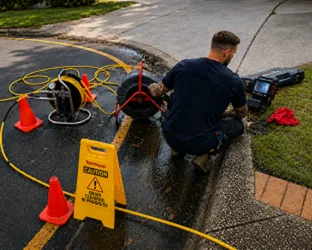
Rows of joined terraces often share ageing drainage runs, so a blockage in one can affect its neighbours. A camera pinpoints it fast.
Before anything else, work out whether the failure sits inside your lot or on common property, because that decides who authorises the work and who is billed. As a rule of thumb: a fixture, a tap or pipework serving only your apartment is usually yours; a stack, a shared sewer line or a stormwater pit serving the building is usually the owners corporation's.
If it is after hours and the building manager is unreachable, we attend, make it safe, and write the report so it names the line and the lot. That report is what settles the invoice question later, and it is far easier to produce on the night than to reconstruct a fortnight afterwards.
The genuine emergency in an older home is often not the size of the fault but the lack of an alternative. A single bathroom out of action with a family in the house is a call-out, whatever the textbook says about severity.
Woollahra’s heritage terraces often still run on original clay and earthenware pipes prone to cracks, sags and collapses. CCTV shows us exactly what’s happening.
We treat it that way. If it is the only toilet, it goes to the front of the queue — and if we can talk you through getting it usable tonight so the visit can happen at daytime rates tomorrow, we will do that instead and say so on the phone.
Grease does not block a line suddenly. It narrows it over months, and the failure arrives on the night of the highest load — a full service, a function, a long weekend.
The cafés and eateries around Queen Street send fats and oils into the drains, which build up and choke the flow over time.
That is why the useful question after a commercial blockage is not what went down the sink tonight, but when the trap was last pumped and the line last jetted. We will give you both dates from what the camera shows, and a realistic interval to keep to.
Steep driveways, stairs down to the door, and no clear place to park all cost minutes in daylight and more after dark.
Woollahra is a heritage-rich pocket of Sydney’s Eastern Suburbs (postcode 2025), bordering Paddington, Bondi Junction and Bellevue Hill. Its Victorian terraces and leafy, tree-lined streets are beautiful, but they sit on some of the oldest pipework in the east, which is where we come in.
It helps enormously if someone can meet the crew at the street with a light on. And if your property has a hard access point — a locked side gate, a shared drive, a set of steps that is the only way in — tell us on the phone rather than when we arrive. It changes what comes off the van and how.
An after-hours visit is about making it safe and usable: clear the blockage, get the fixtures working, and stop anything overflowing. That is nearly always achievable.
What does not happen at midnight is a structural repair. If the camera shows a cracked or root-filled run, you will hear that on the night with the options, and the actual fix is booked in daylight when it can be done properly.
In a block, a single blockage low in the stack shows itself in whichever apartment sits lowest — which is frequently not the apartment that caused it. If your ground-floor shower is backing up when the neighbours run water, the line is telling you the problem is downstream of all of you.
That is worth knowing before anybody starts apportioning blame or cost. A camera up the stack settles it in twenty minutes, and the footage is what the strata manager needs to act on rather than a description of what somebody saw.
What most Sydney plumbers charge to attend. Ask for it on the phone. Anyone who will not name it is telling you something.
Against roughly $120–$160 in business hours. Nights, weekends and public holidays sit at the top of the range.
Call-out, the first stretch of labour and minor parts, for the common jobs: an isolated burst, a blocked toilet, a failed valve.
Slab leaks, gas line faults and anything needing walls opened at 2am climb quickly. You hear the number before we start, not after.
If it can genuinely hold, isolated, contained, water off, we will say so on the phone and book you at daylight rates instead.
The price is agreed before work starts, including at 2am. Figures here are indicative of the 2026 Sydney market rather than a quote from us, you get your own number as a fixed price before any work starts.
Before any booking, the person on the phone tells you what to isolate. That call is where most of the damage is either prevented or done.
You are told when someone can actually be there, not a number designed to keep you on the line. If that is ninety minutes, it is ninety minutes.
Stop the water, make the area safe, find the cause. Only then does a price get put in front of you, and nothing starts until you have agreed it.

Finished on the night wherever the parts allow. Where they do not, you are left watertight and usable, with the return booked before we leave.
Call and describe it. If it can hold, we will tell you, and book you at daytime rates. If it cannot, you will be glad you rang tonight.
Phone is quickest at night. The form works too and reaches the crew covering Woollahra rather than a national call centre.

Leave your details and our local Woollahra team will call you back fast.